AT ALIVE AFTER FIVE: PICKWICK!

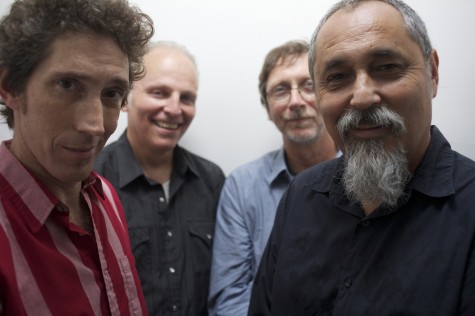
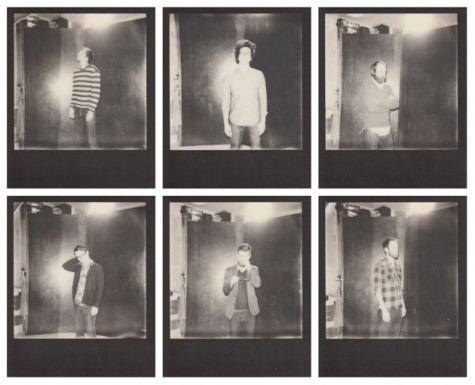
PICKWICK_Polaroids_1This week’s Alive After Five headliner: Pickwick
Go Listen Boise local opener: Thomas Paul

ABOUT PICKWICK

Pickwick was formed in 2008 when singer Galen Disston began writing songs on his acoustic guitar while drummer Matt Emmett kept time in the background. The duo settled on the name as an homage to ‘The Ostrich,’ an obscure dance song written by Lou Reed and released by Pickwick Records in 1964. With the later additions of Emmett’s childhood friend Cassady Lillstrom on keys, Kory Kruckenberg on vibraphone, and brothers Garrett and Michael Parker on bass and guitar, the six-piece began playing shows in small clubs around Seattle.

By the beginning of 2010 the band was in a state of disarray. Frustrated by the direction the music was taking, the band began having discussions about throwing in the towel and going their separate ways. Up until that point, band members had little to do with the writing process and simply added color to Disston’s songs. Ultimately, the band decided to throw out all of their old material and start over from scratch with a new collaborative approach to songwriting. This rebirth allowed the band to take a new look at their individual and collective strengths, as well as look to new places for inspiration.

Raised on indie rock and a love for lo-fi garage bands, the members of Pickwick found themselves entrenched in underground gospel and blues recordings from the 1950s and 60s as well as popular northern soul artists. This new reference point combined with a renewed appreciation for UK bands like The Animals, Spencer Davis Group, and The Zombies helped the members of Pickwick cultivate their own unique take on garage rock, gospel, and 60s-era pop while interpreting those genres through a modern lens.

Along with a shift in musical aesthetic, Disston began exploring darker, more complicated themes in the lyrics of his songs. Contrasting stories of murder, mental illness, and confused sexual identity with major chords, three-part harmonies, and church organs. This unlikely pairing quickly became a mainstay of the band’s approach to songwriting. “I’ve always been drawn to music that seems a bit schizophrenic,” says Disston.

Inspired by a new burst of creative output, the band wasted little time to self-release their music. Instead of waiting to record a full-length record, the band decided to do things on their own terms, putting their music out exclusively on vinyl with three installments of a 7-inch series. Each 45 was accompanied by a record release show at a different club in Seattle. With the release shows under their belt and a series of DIY live videos gaining attention online, the band had cultivated a strong local following by the middle of 2011.

By late 2011, Seattle independent radio station KEXP caught wind of what the band was doing and began playing the band’s music on-air. By the end of the year Pickwick’s 7-inch series ‘Myths’ was voted the #9 record of the year by KEXP listeners alongside artists such as TV on the Radio, Fleet Foxes, Bon Iver, Wilco, Adele and Radiohead.

The band released their first full-length album Can’t Talk Medicine in early 2013.
AT ALIVE AFTER FIVE: TONY FURTADO

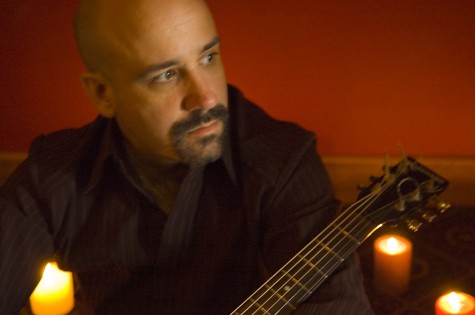
TonyFurtadThis week’s Alive After Five headliner: Tony Furtado
Go Listen Boise local opener: The High Tone Music Show featuring Sean Rogers, Gary Eller and friends

ABOUT TONY FURTADO

Tony Furtado is an indie record label’s dream artist. He has lived primarily on the road for the last two decades. He is gregarious, engaging and entertaining, on and off stage. He’s been called a genius on banjo and slide guitar and his own creative interpretation-hybrid of Americana and indie rock is captivating. Onstage, whether playing with a band or solo, he owns the room, mixing stories of his travels with musicianship that is off the charts.

About Live From Mississippi Studios: On Nov 25, 2011, Tony and his band—some of Portland’s finest young musicians—played 2 exciting sets to a packed house at one of Portland’s guiding light venues for indie rock, Americana, and folk music, Mississippi Studios. The show was recorded and mixed by Rob Stroup (8-Ball Studios) and filmed by a new collective of young filmmakers called Devious Goldfish. The whole project was funded by an interactive Kickstarter campaign where Tony offered up concerts, CDs and even some of his sculpturework as incentives for pledges. Feeding off the thread of energy from the crowd, the performance was riveting and sincere, and the filmmakers captured that on-stage intimacy and raw emotion rarely accessible to the audience. The result is a stunning CD/DVD set, a follow-up to Tony’s 2011 release, Golden (which remained on the Americana top 40 chart for months).

“I think some of my best recordings have actually been captured by bootleggers recording my band live, because in that moment, I’m just not thinking about it. All my energy is focused on the love of playing music and rolling with the moment. It’s a give and take from the audience to the stage, and back. And the music that is created is something that otherwise might not occur without that flow.” — Tony Furtado

QUICK AND EASY BOYS IN-STORE FRIDAY

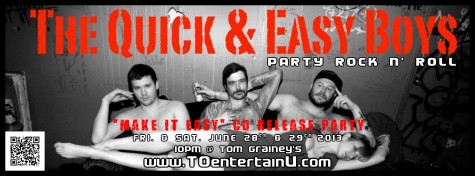
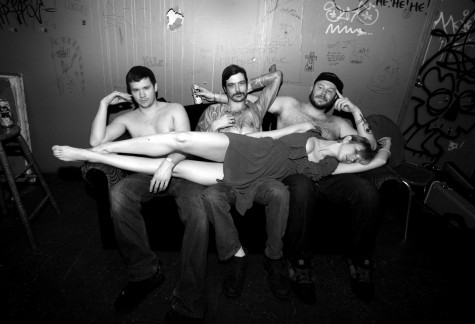
13.6.28 and 29 - QEB cd release Make it EasyQEB_highresThe Quick and Easy Boys will perform live at The Record Exchange (1105 W. Idaho St., Downtown Boise) at 6p.m. Friday, June 28. The band is performing a pair of release shows celebrating their new album Make It Easy on Friday, June 28 and Saturday, June 29 at Tom Grainey’s (10 p.m. both nights; $5 at the door; 21 and older). Buy the CD at the in-store ($9.99) and get free admission to one of the shows! As always, this Record Exchange in-store event is free and all ages!

ABOUT THE QUICK AND EASY BOYS

make it easyThe funky R&B, psychedelic rock, garage-pop of this Portland power-trio is representative of an emerging West Coast post-jam band sound, in which the 80s and 90s pop-rock-funk of L.A. has merged with an indie rock feel and an ability to extend the core rock songs through live improvisation.

The Quick & Easy Boys bring an element of honky-tonk into this mix and arrive at a sound akin to The Minutemen, My Morning Jacket, The Red Hot Chili Peppers and Funkadelic rolled into one. Formed in Eugene, Oregon, in 2005, the band moved to Portland and released their first recording—Bad Decisions With Good People—in between jaunts up-and-down the Pacific Coast, then headed out on their first national tour in 2009. By the end of 2011, they had toured the country two more times and released their second album, Red Light Rabbit (2010).

On the road, the band has opened for an eclectic array of talent, including Deer Tick, Blitzen Trapper, The Bridge, Iglu & Hartly, The Pimps of Joytime, Southern Culture On The Skids, Big Sam’s Funky Nation and many others, subjecting unsuspecting audiences to The Quick & Easy Boys’ interactive party—complete with thought provoking lyrics, quirky eclecticism and unexpected stage antics.

The trio of Jimmy Russell (guitar), Sean Badders (bass) and Michael Goetz (drums) has gained a reputation for moving a crowd all-night long, whether on a big festival stage or in the corner of a tiny watering hole, and for pouring out every ounce of their energy, leaving nothing behind. In appreciation, home town crowds scream out “Yeah Bud!” at every show, and it appears that this disturbing trend is spreading to other markets …

AT ALIVE AFTER FIVE: SALLIE FORD & THE SOUND OUTSIDE + FINN RIGGINS!

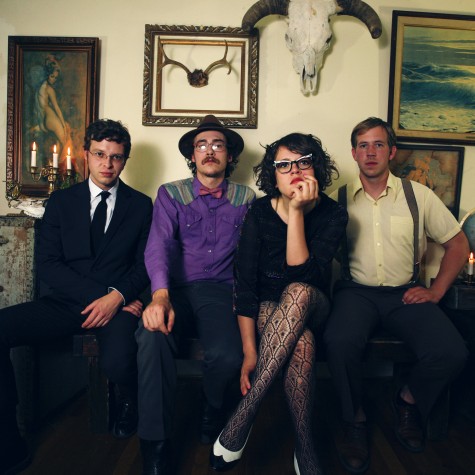
sallie fordThis week’s Alive After Five headliner: Sallie Ford and the Sound Outside
Go Listen Boise local opener: Finn Riggins

ABOUT SALLIE FORD AND THE SOUND OUTSIDE

Sallie Ford & The Sound Outside’s new record Untamed Beast is a visceral rock and roll romp. Like a cross between “Ella Fitzgerald and Tom Waits” (Mashable) Sallie has established herself as one of the most powerful female voices in indie rock. Ford and her group – Tyler Tornfelt (upright bass), Ford Tennis (drums), and Jeffrey Munger (lead guitar) – recorded the album’s 11 tracks with Adam Landry and Justin Collins (Deer Tick, Middle Brother) at Jackpot! Studios in the band’s hometown of Portland, Oregon.

On the new album the band creates a powerful statement on finding freedom through defying conformity. Through clever (often racy) turns of phrase, Sallie twists traditional notions of gender and genre. She says “it’s time for a girl to infiltrate the boys world of rock n roll and grab it by the balls. To me rock n roll isn’t a genre, it’s an energy.” From the exuberantly sexy “Do Me Right” to the free-spirited cry of “Party Kids,” Untamed Beast has a lust for life.

Untamed Beast is the follow up to 2011′s Dirty Radio, which Brooklyn Vegan called “phenomenal [and] monumental.” In 2011, Sallie Ford & The Sound Outside made their national television debut on Letterman, were one of the most talked about new performers at Bonnaroo, the Newport Folk Fest and Bumbershoot, and were championed by Jack White and The Avett Brothers.

AT ALIVE AFTER FIVE: THE IGUANAS – MOVED INDOORS TO LIQUID TONIGHT!

iguanasNOTE: Alive After Five has been moved indoors to Liquid on account of the weather.

This week’s Alive After Five headliner: The Iguanas
Go Listen Boise local opener: Steve Fulton

ABOUT THE IGUANAS

The word “Americana” gets tossed around rather loosely these days; it can mean anything from a hipster with a recently-discovered acoustic guitar to a decades-long denizen of the Grand Ole Opry. But when you set aside the Johnny-come-rootly types from the real deal, it’s a sure bet that you’re going to stray into Iguana territory. Based out of New Orleans for the past couple of decades – save for a short, Katrina-imposed exile in Austin – the Iguanas define a sound of Americana that crosses cultures, styles, eras… and even languages.

Their latest album, Sin to Sin, is their first studio recording since 2008’s If You Should Ever Fall on Hard Times, and its release coincides with their appearance at the New Orleans Jazz & Heritage Festival.

“The title for the new album,” says sax player/vocalist Joe Cabral, “comes from one of the tracks we cut during the sessions that didn’t make it onto the record.” At this point, the band’s guitarist and vocalist Rod Hodges picks up the trail. “It’s a line from a tune called ‘Blues for Juarez,’” he says, “that goes, ‘We rode the back roads from sin to sin.’”

The Iguanas’ two-decade road may not exactly have driven them from sin to sin, but it’s taken them all over the map, both figuratively and literally. While bassist René Coman is the only member of the band who is a native of the Crescent City, a languid swampiness so deeply suffuses their sound that you can almost smell the peanut shells on the floor. But there’s far more depth to it than the N’Awlins patina that rests, sometimes lightly, sometimes heavily, on anything the city touches. It’s almost as if the Iguanas dragged sand up from Juarez and mud from the Mississippi Delta, threw them both into the white-hot crucible of rock, and built their foundation from there, with drummer Doug Garrison anchoring their sound deep in the groove.

“Spanish was spoken around the house when I was growing up,” says Cabral, “but I was listening to all kinds of stuff: Herb Alpert, Boots Randolph, country music, rock, polkas… The area of south Omaha where I grew up was the classic American blue collar ethnic melting pot of Irish, Italians, Poles, Mexican-Americans, who all sort of brought these pieces into the mix.”

“How could we not wind up in New Orleans?” asks Rod Hodges, a little rhetorically. “I mean, at Tipitina’s they might have Doug Sahm one night and Fela Kuti the next.” And sure enough, even on their first album (The Iguanas, Margaritaville/MCA 1993), the band was comfortable planting Allen Toussaint’s oft-covered “Fortune Teller” cheek-by-jowl with cumbia master Celso Piña’s “Por Mi Camino (Along My Way),” leading Entertainment Weekly to conclude, “never have accordions and saxophones been so much in love.” People echoed that sentiment in their review of Nuevo Boogaloo (Margaritaville/MCA 1994), saying “any group that can turn on a dime from a gorgeous R&B ballad like “Somebody Help Me” to the steamy tropical funk of “La Tentación” is clearly here to stay.

And stay they have, through half a dozen studio albums, countless tours and JazzFest appearances, and a flood that did its best to take their adopted city with it. It’s a testament to the band’s longevity and endurance that they’re still configured pretty much the way they were 20 years ago, while their onetime label, MCA, has gone the way of mousse-abused coiffures and Hammer pants.

Joe Cabral is pretty philosophical about the band’s persistence in the face of challenges that would have felled – indeed, have felled – lesser bands. “First of all, this is all we know how to do; we’re musicians. But more than that,” he continues, “we respect the power of the band as an entity, and each individual in the band steps up to play his part. When it’s good, that’s really what it’s all about.

Rod Hodges agrees. “I don’t want to get all heady and mystical about this, but it’s not really an outward reward we’re looking for. We still all enjoy playing music, we all get along, and finding a group of people who can say that after all this time is a pretty rare thing.”