THE RECORD EXCHANGE REVIEW: THOMAS ON MDOU MOCTAR’S NEW ALBUM ‘FUNERAL FOR JUSTICE’ AND TREEFORT HALL SHOW

Artist: Mdou Moctar
Album: Funeral for Justice
Concert: Treefort Music Hall, October 19, 2024
Reviewer: Thomas Metzger

ALBUM REVIEW:

Mdou Moctar’s newest album Funeral for Justice is a pyrotechnic, explosive modern-day blend of Saharan blues and Jimi Hendrix, with tracks about brutal government regimes and family tradition. 

Mahamadou Souleymane, better known as Mdou Moctar, is a Tuareg songwriter/musician from Niger. He made his first guitar himself, using spare pieces of wood and bicycle cables. However, the small village of Agadez he grew up in did not allow secular music, so he had to practice in secret. His practice sure paid off, as you can argue he is one of the most talented, interesting guitar players out there right now, with constant comparisons to Jimi Hendrix.

Lightning fast solos, chugging 6/4 grooves and lyrics about his home village were prominent on his last full length album Afrique Victime. Funeral for Justice takes those points and turns the amplifier up to 11. “Funeral” has Moctar singing about oppressive government coups and the longing of freedom for his people while shredding these absolutely face-melting solos, especially on the track “Imouhar,” meaning “brother(s).”  The track opens with a subdued Saharan Blues riff, and group vocals come in singing:

 “Imouhar, you know this indeed we have a written history/Written in books and the whole world knows it.” 

Then, the track opens up as an explosion of electric guitar hitting you square in the face. After pleading to his people to not abandon their traditions, Moctar erupts into another mind-bending solo, now using his guitar to assert his frustration and persuade his people. Moctar does not hold back. You know exactly what he is feeling.

The songs on Funeral for Justice are inherently political, mostly inspired by the Nigerian government being taken over by a violent, right-wing military coup back in 2023 while touring for Afrique. It was because of this coup that Moctar and his band couldn’t return to their home country, and were afraid for the lives of their loved ones. The final track “Modern Slaves” shows Moctar yearning for peace and safety for his home, singing, “Oh world, why be so selective about human beings?/ My people are crying while you laugh.” 

Moctar’s feelings about oppressive regimes on this album are relatable to anyone who has gone through it: the longing for peace and stability, and the uncertainty of what will come next. While Funeral for Justice is a cry for help and for freedom from the abuse of fascist powers, Moctar will also release Tears of Injustice in 2025, which features an entire rerecording of the album on acoustic instruments, in what Matador Records describes as “the sound of grief” and “the meditative mirror-image to the blistering original.”
CONCERT REVIEW:

While Moctar’s studio albums do a good job demonstrating his talent on guitar, where he truly shines, in my opinion, is in the live setting. 

Fast-forward to October 19, 2024, Treefort Music Hall: Can and Neu playing over the house PA, providing just a small snippet of the classic sounds of the past that Moctar and Co. have adopted into their playing. While there were many events happening around the Treasure Valley that night, those who chose to see Moctar were delivered an amazing performance. 

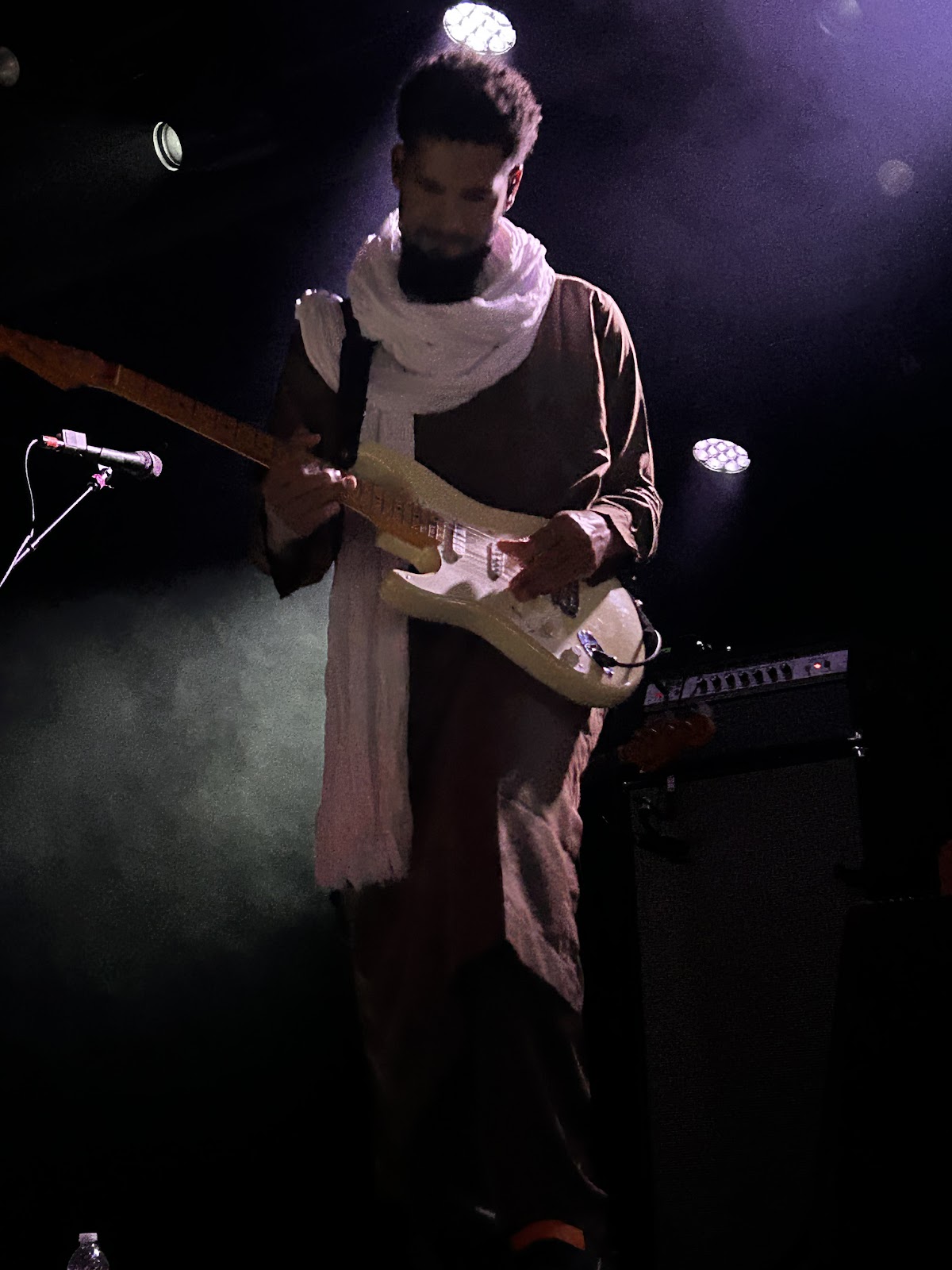
The lights go out, and a tape-loop recording consisting of chicken roosts and background wind and conversation plays over the house speakers. Moctar and his band stroll out on stage, dressed in Nigerian garments and huge white scarves. Very nonchalant, not saying much to the crowd. Just a simple smile and wave. Mdou Moctar is a man of few words, but needless to say, his playing does the talking for him. 

And then, the tape loop ends and the band launches into the opening track of Funeral for Justice, and in an instant, we are 0 to 100 mph. Moctar’s fiery guitar chops light up the crowd, myself included. 

While the similarities of Moctar and Hendrix are apparent, Moctar has formed his own style and path of guitar playing, borrowing the stylings of Saharan blues legend Ali Farka Touré and mashing them together with raunchy blues riffs played at the speed of light. Listening or watching him solo with no pick is enough to make even the most seasoned of guitar vets go “Holy s***!” 

While Moctar may be across the world playing shows night after night, he certainly hasn’t forgotten about his people. The passion and intensity he puts in every single riff, jam and song is felt across the entire room. 

And just like Hendrix had Mitch Mitchell and Noel Redding laying the foundation for Hendrix to go crazy, Moctar’s backing band – rhythm guitarist Ahmoudou Madassane, drummer Souleymane Ibrahim and bassist/producer Mikey Coltun – were putting in work, laying the steady 6/4 grooves for Moctar to release his anguish and frustration through his guitar. Drummer Ibrahim pounds those drums and provides an awesome mix of rock, blues, disco and Afrobeat rhythms throughout his playing. Guitarist Madassane provided the tight rhythm guitar, and bassist Coltun spawned thunderous bass that you could feel in your entire body.

It surely can’t be easy laying the foundation for a player like Moctar to do his thing, but his band members make it look so easy. With someone like Moctar taking the lead, the band needs to be rock solid and grounded, and they very much were. Songs can spin off into extended, krautrock-meets-Saharan-blues-style jams, where Moctar takes the lead and plays like his life depends on it. And in a way, it does. 

About halfway through, we launch into another explosive jam. Surprisingly, about midway through the 6/4 shred-fest, the beat switches to a 4/4 disco/funk groove that couldn’t be resisted by the crowd. It was a nice foray into a style that we maybe don’t often associate with Moctar, but could be reminiscent of late-era W.I.T.C.H. (We Intend To Cause Havoc) albums. 

After about an hour and 15 minutes of face-melting solos, the band exits the stage, the crowd screaming and clamoring for more. Moctar returns to the stage, solo. The crowd loses it. He slowly picks up and tunes his guitar, and in this moment of anticipation and “what will happen next,” I have never heard Treefort Music Hall so quiet. No barware clinking, no background conversations; you could hear a pin drop. Everyone was waiting in awe at what he would do next.

After the rest of the band returns, they launch into a final, atomic-level explosion of a jam, Moctar taking to the front of stage. He knows what the crowd wants, and he is feeding off it. Running both hands up and down the neck of his Olympic White Fender Strat (similar to Hendrix), Moctar shreds his most intense performance of the entire night. He wants the crowd to remember this show, and boy will it be hard to ever forget.

While Funeral for Justice is great on a nice turntable and speakers, truly nothing compares to seeing Moctar live. The jams get more intense, and the energy in the room is irresistible. The face-melting solos blasting the noggins of everyone inside Treefort Music Hall that night will linger on in the minds of everyone who was there, and I truly feel bad for anyone who wasn’t there to experience it. Moctar is a once-in-a-lifetime talent, one that I will drop everything to go see if they come to town, and so should you.

THE RECORD EXCHANGE REVIEW: JOHN O ON MIRANDA LAMBERT’S ‘POSTCARDS FROM TEXAS’

Artist: Miranda Lambert
Album: Postcards from Texas
Reviewer: John O’Neil

Innovation is a concept often misunderstood. In country music, too much change is seen as a betrayal of the whole concept of “three chords and the truth.” But nothing comes out of nowhere; everything is built on a foundation of things that came before. How much groundbreaking takes place is secondary to the fundamental basis of music: does it speak to me, to my heart and soul, and am I inspired to sing along?

Postcards from Texas finds Miranda Lambert in control of her considerable gifts as a singer, player, writer and mogul. There is nothing that she turns her attention to that she doesn’t excel at. The songs are steeped in Texas place names, which works here because of the fun the singer is obviously having speaking her truth. It’s serious fun too, because often the best response to the challenges that a person faces is to find humor in your circumstances, and to laugh at misfortune.

This album is a masterclass in collaboration. No less than 18 songwriters are credited on this record, with Lambert co-writing 10 of them. It all sounds consistent with the overall vision, even though the songs are diverse in content and melody. They hearken back to the classic country sound of artists like George Strait, the folky storytelling of Townes Van Zandt and Guy Clark, the plain spoken “tell it like it is” songs of Loretta Lynn, combined with guitar driven country-rock of the Byrds, Gram Parsons, Tom Petty and the Heartbreakers. She is a great singer, delivering time and time again with confidence and power. Despite the number of collaborators, the overall sound is hers. The hooks are huge, and memorable. The guitar playing is great, not overbearing or flashy, just perfect for the song. Nothing is out of place, and there is not a bad song on the record. And there are clever moments of wordplay that could devolve into gimmickry in less-capable hands (“Armadillo,” “Looking Back on Luckenbach,” “Alimony”) that instead hearken back to the great story songs of classic country. And there are great stories contained here.

Now in her forties, Miranda Lambert seems as driven as ever. Given the number of enterprises she has taken on outside of music, both charitable and commercial, it makes her music even more remarkable, because she delivers on every promise. Her mantra, which has been constant since before she signed her first record deal, is, “If it’s a maybe, it’s a no.” (reference, pg 57 “Her Country” by Marissa R. Moss) – anything that isn’t true to her Texas country roots. It’s no small thing to remain true to yourself, going against the grain while simultaneously honoring the things that make your sound what it is. She is real, and anything that is not real to her is not something she will do. I have no reason to believe that will ever change. And I will always listen to her records, as long as she wants to make them.

THE RECORD EXCHANGE REVIEW: CHAD ON MORPHINE’S ‘CURE FOR PAIN’

Artist: Morphine
Album: Cure for Pain
Reviewer: Chad Dryden

It’s hard to imagine here in 2024 that vinyl ever went through a “dead era,” but if you hear a collector use that term, it’s likely they’re talking about the ’90s. And I can tell you with certainty (because I was there) that’s exactly what the decade was like for vinyl while the compact disc was peaking.

In the here and now, that means countless beloved albums from the ’90s are either woefully scarce (and painfully expensive) due to limited demand for the format (and thus minuscule original press runs) or unavailable on vinyl – most artists and labels simply never bothered to make it.

Fortunately, in recent years the ’90s have been getting their just due, as the racks at stores like ours are filled with vinyl reissues from an array of artists large and small who made their mark in the last decade of the millennium. Morphine is one of them.

Cure for Pain, originally released in September 1993, was virtually impossible to find on vinyl upon its release – only one pressing surfaced, in 1994, and that was in Brazil. The first U.S. pressing finally arrived in 2011, and now Rhino Records has cut a fresh remaster from the original tapes in conjunction with its annual Rocktober reissue series.

The album was and remains one of my favorite albums from the ’90s, and is universally accepted, more or less, as Morphine’s crowning achievement. The Boston trio – principal songwriter Mark Sandman on vocals and homemade two-string slide bass guitar; Dana Colley on baritone and tenor sax, which he often played simultaneously on stage; and Jerome Deupree then Billy Conway on drums – were scene vets who came together with a decidedly unique concept for jazz-influenced underground rock. In lesser hands, it would be a one-trick gimmick like so many from the era, but the sheer talent of the musicians and Sandman’s fully-formed vision for their aesthetic resulted in a series of incredible albums leading up to his death on stage by heart attack in 1999.

Sandman – whose wry, hipster-cool wit was always on display in interviews and on stage – alternately referred to the Morphine sound as “low rock” or, in a winking nod to the times, “implied grunge.” And certainly there’s a low-end aggression to some of their songs, but ultimately the groove triumphs. Sandman makes the most of his two strings, crafting slinky, sultry and sometimes feedback-soaked bass lines that provide more color than most rock bassists can conjure from a traditional four-string. It’s a foundation for his bohemian lounge-lizard tales, the sort of hazy cigarette-smoke late-night noir that traveled a through line from mid-century jazz to Tom Waits to Jim Jarmusch films. Morphine provided a soundtrack for the fedora-clad hepcats of the ’90s, and it’s no surprise their songs found their way into movies of the time like Get Shorty.

Morphine’s music may have been the product of a certain era and a certain place, but unlike many artists and albums from the ’90s American underground, the moody, infectious Cure for Pain does not come on like a time capsule here in 2024. Seek it out if you haven’t already, or use this fantastic Rocktober reissue as an excuse to revisit a certified classic, then come back for more on Black Friday when Morphine’s B-Sides and Otherwise compilation gets its first-ever vinyl release.

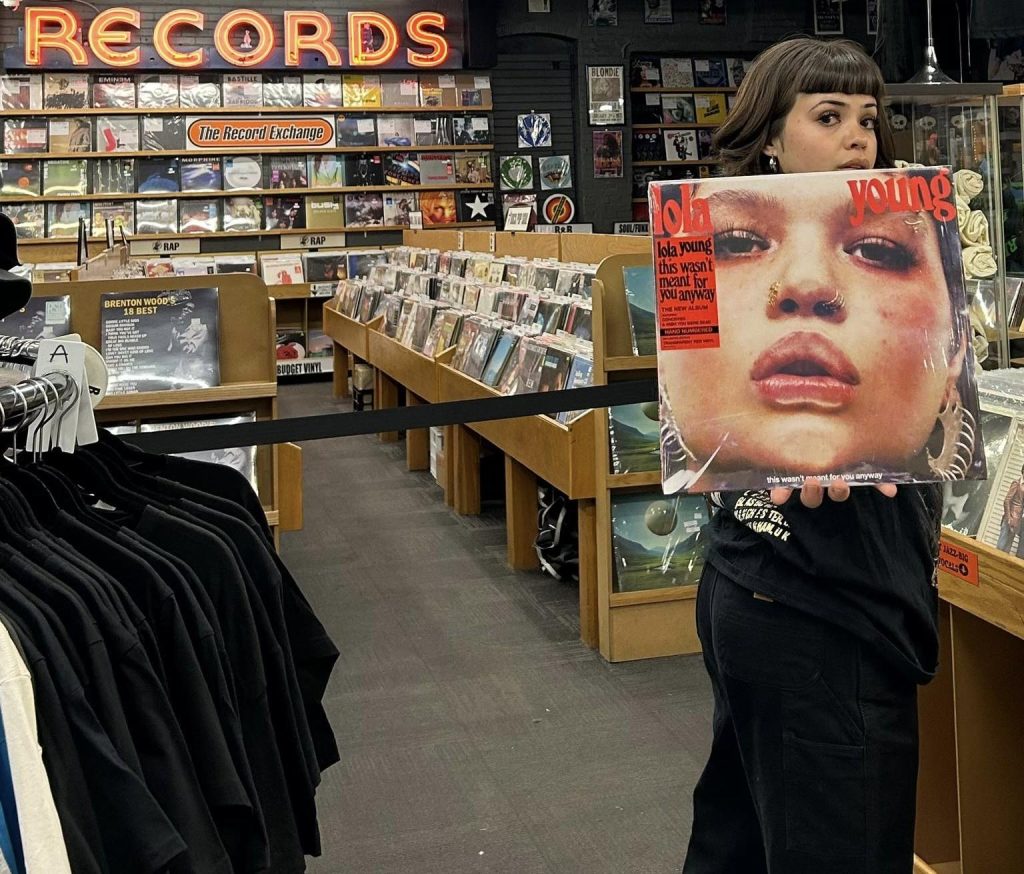
THE RECORD EXCHANGE REVIEW: TATIANA ON LOLA YOUNG’S ‘THIS WASN’T MEANT FOR YOU ANYWAY’

Artist: Lola Young
Album: This Wasn’t Meant For You Anyway
Reviewer: Tatiana Silva

This Wasn’t Meant For You Anyway is the ambitious and unafraid Lola Young’s sophomore album. Lola hails from the UK and rose to place fourth in the BBC Sound of 2022 list after being nominated for the Brit Rising Star Award in 2021. Her downtempo dreamy cover of “Together in Electric Dreams” for the John Lewis Christmas Advert in 2021 solidly put her on the map, but her fans know she’s been on the scene since 2019. Lola is no stranger to great talent and has Solomonophonic (Jared Solomon) as her righthand man and executive producer. He is most known for his work with Remi Wolf, Brockhampton and Dominic Fike.

I discovered Lola Young while mindlessly scrolling on whichever platform I was on at the time and immediately was taken aback by the stark freshness of the familiarity Young portrayed in her videos. Singing directly into the phone camera anywhere from public transport, a laundromat or a busy intersection about things like heartbreak and why she could never fit a particular mold. While a DIY approach could potentially inhibit an artist from conveying their full expression, this is the rawness Lola wants to depict and certainly details lyrically in her music.

This Wasn’t Meant For You Anyway is one to be belted and one to be listened to in its entirety. Lola processes her pain, anguish, self-hatred, love lost, love gained and “weird other things.” She admits that it was a very strenuous process to write but equally cathartic and amazing on a spiritual level. Which was always meant to be the case, as the album wasn’t meant for you anyway. Yet I am eternally grateful that this project was in fact shared.

Lola is honest and forthcoming in her struggles with mental health, being diagnosed with schizoaffective disorder, and traversing the ever-rocky love realm. Lola writes straight from the heart and by order of experience and intuition, making for almost too fine-pointed lyrics that she laughs at the fact that she must remember to keep some of it metaphorical (namely the choruses) so that she isn’t just singing directly to the person.

This Wasn’t Meant For You Anyway is 11 tracks but might as well be a 12-step program for the heartbroken. Opening song “Good Books” hits with the zinger, “I work hard to stay in your good books but you don’t read so why do I try?” The proceeding tracks “Conceited,” “Wish You Were Dead” and “Big Brown Eyes” are the ones meant for belting at the top of your lungs in an interpretive somatic rage fashion. Lola fully opens the door into her universe, as “Messy” could be sung about your relationship to anyone, never being quite enough of anything to check the green box. Hold on because “Walk On By” and “You Noticed” will have you wanting a hot candlelit bath to sob in. Breakups open the door for new entanglements; “Crush” and “Fuck” touch on the fine line of moving on and falling into old habits. The album closes with a solemn and gentle ode to Lola’s intrusive thoughts. And like a Marvel movie if you wait until the very very very end, there’s bits of pure gold that I’ll just let you discover on your own.

I truly believe that Lola Young has created an album that deserves any and all attention and accolades it receives. This Wasn’t Meant For You Anyway is a cathartic indie-pop album written for the soul and not for the glorification of fame and the rich. The type of album I am already daydreaming about singing to when I have a tough bout, one that my future children will probably hear over and over, an album to revisit, and like a catch-up with a friend that feels like the most oxygen you’ve had in weeks.

Lola is currently on tour in the US and is playing Portland and Seattle at the end of the month. She claims to love the energy of American crowds so let’s see if we can get her to stop in Boise on the next tour! In the meantime, grab the record (they’re red and hand-numbered!) and thanks for reading!

XOXO Tati

THE RECORD EXCHANGE REVIEW: THOMAS ON THE SELF-TITLED DEBUT FROM LA LOM (THE LOS ANGELES LEAGUE OF MUSICIANS)

Artist: LA LOM
Album: The Los Angeles League of Musicians
Reviewer: Thomas Metzger

When LA natives Zac Sokolow (guitar), Jake Faulkner (bass) and Nicholas Baker (drums/percussion) first got together in 2019, they were tasked to provide background music for five nights at the famous Roosevelt Hotel in Los Angeles. However, they soon found that their talents deserved more than to be a backdrop. 

LA LOM (the Los Angeles League of Musicians) come from a rich tapestry of family history and culture: Sokolow’s background performing in his father’s Argentinian bluegrass band, Baker’s mother embracing Latin and Mexican radio and Faulkner learning on his father’s guitar while being raised in Venice, Italy. These roots all seep their way into their self-titled debut album. Starting off with “Angels Point,” it includes reverb-drenched, spaghetti-western guitar that you’d find in a Morricone movie set to a groovy cumbia beat that will bring you back to those hot summer days.

The track “Ghosts of Gardena” includes beautiful string interludes, which then trade bars with the romantic lead guitar from Sokolow. “Figueroa” has almost a sense of ghoulishness, yet is still uptempo enough to keep your feet dancing. Either track could easily fit in the intro of a Tarantino movie. 

The production of this album is also very vintage sounding. Lots of surfy-style guitars doused in reverb and tremolo, like on the song “Lucia,” mesh well with the light piano and strings. The lofi sound of the record gives it a warm feeling, which only complements the romanticized nostalgia, as well as providing a fiery contrast for the performances throughout the duration of the album. 

“‘72 Monte Carlo” picks up the pace with its pounding and tribal drums, paired with a slick lead synth that might just get stuck in your head if you have the song on repeat. 

The track “Moonlight Over Montebello,” with its slow, swinging beat and groove under backlit strings and slide guitar, is a track that is just aching for a dance partner.

Although they may have gotten their start providing background ambiance, this album is anything but. While largely instrumental, it still deserves your attention, as the performances are fiery and soulful. While summer might be over (for now), the debut full-length from LA LOM is the perfect album for when you’re nostalgic for old summer days, or to feel the warm sunshine when it is the dead of winter. It’ll be back before you know it.

Favorite Tracks: “Lorena,” “‘72 Monte Carlo,” “Moonlight Over Montebello” 
For fans of: Hermanos Gutierrez, cumbia, Latin jazz, BadBadNotGood, Morricone and/or Tarantino movies